Radiotherapy Week 1

Finally, the wait is over – I have started my radiotherapy signalling the start of what should be the last chapter of my prostate cancer. On the day for my first round of 20 radiotherapy treatments. I didn’t feel particularly nervous or anxious. I needed a 5.20 alarm call as my appointment was just after 8.00 by which time, I needed a full bladder and empty bowel which I achieved!

The moment arrived and I went into the room where a machine nicknamed Brunel was waiting for me. The nurses positioned me very precisely on the bed and then retreated as Brunel literally sprang in to action.

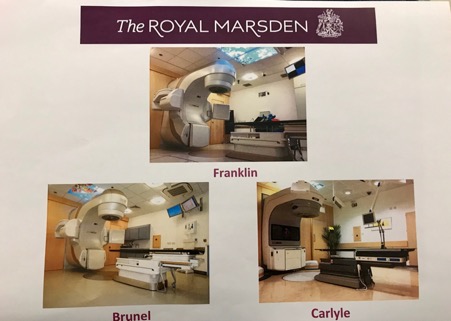
Brunel cost £2.3million and is a Varian TrueBeam machine which treats up to 40 patients a day across a variety of tumour types, including breast, lung, head, neck, prostate, gastrointestinal and gynaecological cancers.

It can deliver all forms of advanced external-beam radiation to kill cancer including image-guided radiotherapy (IGRT), intensity-modulated radiotherapy (IMRT), stereotactic body radiotherapy (SBRT) and volumetric modulated arc therapy (VMAT).

I know this all sounds a bit technical, but I think it’s helpful to know. My particular treatment is IMRT. The imaging enables the radiographer to target tumours with sub-millimetre precision. This is why the alignment with my tattoos and gold seeds is so important as it cuts down the side effects on the surrounding organs.

The three Truebeam machines at The Royal Marsden. My machine is Brunel and it will derail my cancer!
The result of cutbacks! (not really)

When I awoke after three doses that week, I felt very slow but after an hour of activity felt much more with it. I rolled up to The Royal Marsden and my final treatment for the week was done and dusted inside 30 minutes. Then back to Paddington to catch the train home, or so I thought. My train was cancelled, and I had an evening commitment. For the first time in the week I felt frazzled. Three and a half hours later I was where I needed to be and felt much better.

Saturday morning arrived and I felt perfectly normal. A two-mile dog walk and a set of tennis did not tire me. It is early days, however, with a fifth of my treatment is complete.

Howzat!

This is an extract from an article in The Times written by Mike Atherton about the England World Cup semi-final which made me think…

‘Today’s semi-final against Australia represents a once in a lifetime opportunity. It will be a full cycle, 20 years or thereabouts, before the World Cup returns here, by which time every England player will have retired. The Times will have a new cricket correspondent and some readers of this newspaper, sad to say will no longer be around ‘

I was enough to go to the final and witness this incredible game, extraordinary finish and England’s victory. It left me with an outer glow to match my inner radiotherapy glow. Believe me, I have every intention of being there in 20 years’ time!

And in other news

The Friday before my treatment Lynda and I had a fabulous time with some dear friends on their boat cruising down the Dorset coast. A perfect day.

Next time

Week 2 of my treatment and I’ll describe what it’s like to have radiotherapy. 

Pre-radiotherapy golden opportunity at The Royal Marsden

This blog is one of my exciting as it details the innovative gold seed implant process that the amazing team at The Royal Marsden administered ahead of my radiotherapy starting next week…..

The Gold Standard

As I mentioned in my previous blog, I’m resistant to the usual antibiotics used to fight infection during the implantation of gold seeds around the prostate. Not to worry, this type of resistance is quite common, and the alternative is an antibiotic called metronidazole administered via a catheter. Metronidazole is an interesting drug because it’s also prescribed to alcoholics and makes them feel very ill if they drink. I was told not to have any alcohol for 48 hours which was a little unfortunate as I was attending a charity drinks reception the following evening, but I digress…

After a short wait I was ready for the procedure to implant the three gold seeds around the prostate to help target the radiotherapy beam. Suffice to say it was pretty unpleasant and without local anaesthetic as that would only create an unnecessary infection site. It was a question of ‘grin and bear it’, except I didn’t grin, I grimaced. 

However, the pain was temporary, and I played 2.5 hours of tennis the next day with no sign of infection.

This is the instrument that delivers the gold seeds. Ouch!

My ‘first’ scan

My poor old prostate needed a week to recover and settle before the CT scan could be carried out. This scan is critical as it is used to accurately target the radiotherapy beam. Some preparation is needed beforehand. The first is to have a full bladder – easily enough done.  The second is to have an empty bowel helped by an enema. Sadly, this didn’t work but we got there in the end.  If you get my drift. 

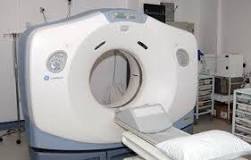
 A CT Scanner. Yes, it may look boring, but this technology has made such a difference to life expectancy. 

Second scan and success!

Four days later and everything fell into place. Literally! The scan took around 10 minutes to complete and then it was tattoo time. Three scratches and that was that. Job done. 

I’m ready for my radiotherapy to start on tomorrow ! It will last for four weeks but I’ll get the weekends off to recover. The prostate will change shape as it shrinks after each treatment and so I’ll need a CT scan before each treatment just to make sure the remainder of the prostate is targeted accurately.

My first fitness class at David Lloyd Fulham

It was time to attend my first Les Mills class at my new home gym, David Lloyd Fulham. The class was called ‘GRIT’ which was as tough as it sounds… It’s a 30-minute high-intensity interval training (HIIT) workout, designed to improve strength, cardiovascular fitness and build muscle. 

It uses barbells, weight plates and bodyweight exercises to hit all major muscle groups. It was an absolute BLAST and I’m looking forward to my next GRIT class.

And in other news

A nice surprise came courtesy of my son, Chris. He had spare tickets for the Beach Boys Concert at the Royal Albert Hall on Tuesday for my daughter and me: we had a fabulous time and helped take my mind far away from the week’s treatment. Thanks Chris!

Next time

The start of radiotherapy. Four weeks to end my cancer!

I’m a Guinea Pig going for Gold

Back from a glorious break in the Dordogne, this blog is about being a guinea pig and feeling the gold star treatment thanks to the innovative team at The Royal Marsden Hospital..

Going for gold

Post radiotherapy preparation involves two main components.

First is the insertion of a gold marker around the prostate to enable the radiographer to target the prostate accurately with Intensity Modulated Radiotherapy.  (IMRT). I’ll also be really trendy by having a couple of tattoos in my pelvic area – again to help with accurate targeting. Gold implants and tattoos – not bad for a 64 year old!

Second is having a CT scan to map the exact position and size of the prostate.

That all sounds very straightforward, however…the weekend before the gold seed procedure I was hit by a tummy bug which meant that the treatment was cancelled. The biggest risk of the procedure is an infection (sepsis or blood poisoning) as it is carried out through the wall of the rectum which, to my non-medical mind, is probably the most bug-ridden part of the body. As a precaution, antibiotics are administered prior to the procedure. However, a blood test confirmed that I am resistant to the most common antibiotics used to treat E. coli. Unfortunately, that is a sign of the times as the general population grows more resistant to these drugs. This in turn, means I will have to have different antibiotics delivered through a catheter. I’ll let you know how that goes!

About being a radiotherapy trial guinea pig…

A trial of 1,952 men (that number must be statistically significant, but I have no idea why!) who suffer from prostate cancer is currently underway and I’ve been selected to take part.

My cancer is a high risk localised prostate cancer and 20-30% of those in my category are likely to have a recurrence following radiotherapy.

The trial I am on is called ‘Pivotal Boost’ and it aims to determine whether treating the pelvic lymph nodes with Intensity Modulated Radiotherapy as well as the prostate improves survival rates, compared to just targeting the prostate.

The trial is randomised, and I have been selected to have my pelvic lymph nodes treated as well as the prostate. Like any trial it will include a control group and three variations to the IMRT treatment. All of the patients will be followed up for disease outcome and quality of life.

I think it’s great that I am part of this research and my hope is that it will play an important part by increasing survival rates.

More information about the trial can be found here https://www.cancerresearchuk.org/about-cancer/find-a-clinical-trial/a-trial-looking-at-different-ways-of-giving-radiotherapy-for-cancer-of-the-prostate-pivotalboost#undefined

PSA update – more progress!

You may recall from previous blogs that my PSA level at the time I was diagnosed with prostate cancer was 5.4. After my prostate reduction operation, it was measured at .029 and now it’s down to .007. Sure and steady progress!

And in other news

Lynda and I have just returned from a wonderful, if all too brief, visit to the Dordogne. My first time there, but Lynda is a serial returner.

And look who’s doing all the hard work!

Next time

My next appointment at the Royal Marsden Hospital is for the gold seed treatment. It seems the older I get the more valuable I become…

My Post Op Appointment at The Royal Marsden

It’s been six weeks since my prostate reduction (TURP) surgery which removed 10 grams of tissue and I feel really good!

On Tuesday I travelled up to The Royal Marsden for my follow up appointment. On arrival I had to do a couple of things.

The first was to fill out a score sheet about how my peeing had improved. The questionnaire asked such things as how many times I had to get up in the night to pee, day time frequency, urgency and so on. Overall there was a 50% improvement compared to my condition pre op. A good result that will continue to improve.

The second task was to do a flow test which measures the flow strength, followed by an ultrasound scan to see how much urine is left in my bladder. Again, another positive result. Flow is twice as strong as pre op with only a miniscule amount left in my bladder. Previously there was a significant amount.

I do, however, need to keep up the pelvic floor exercise and found  a new learning source, David Hughes Pelvic Floor Exercise – The Prostate Clinic – is coming in handy here. Check out the YouTube video here: https://www.youtube.com/watch?v=QHwVglPQR_w

Minor concerns

I had two concerns which I discussed with my urology consultant Mr Cahill (otherwise known to his colleagues as DC or The BOSS) and his colleague Ray Nicholson. Increased urgency and some slight traces of blood in my pee. Mr Cahill reassured me that the urgency (I would describe it as a burning sensation) would be much better after a couple of months. The blood? Well that’s very probably caused by ibuprofen tablets that I am taking to combat my tennis elbow. That should be cured by a hydrocortisone injection that I am having next week. If not, it might need minor surgery.

However, the great news was that my PSA level had dropped from 5.4 to 0.29. PSA in essence measures the food supply to the tumour and starving the enemy is always a winning tactic. All in all, a stunning result. My immense thanks to all at The Royal Marsden!

David Lloyd Fulham

I happily walked a mile or so down Fulham Broadway to introduce myself to the David Lloyd Fitness Club which will be my home gym during my radiotherapy. Atif, the Assistant Manager at the Club, took me through the membership paperwork before showing me the club facilities. It’s not an exaggeration to say that it is one of the largest and most impressive gyms I have ever seen.

My absolute favourite and all-important Les Mills classes are taught by an instructor but are also available as virtual sessions via a large screen in some gyms, including David Lloyd Fulham for the maximum flexibility. I think I’m going to like it here!

My excellent results combined with the warm welcome at David Lloyd Leisure made this a very good day’s work and I returned home happy.

And in other news

If you remember, I am going to visit an art gallery each day during radiotherapy. And it’s very relevant that Lynda, my significant other, is an artist. In fact, she has an open art studio this week and its proving to be a huge success. 

My son works for a company that sponsors cricket and I was very proud to see him on TV presenting the man of the match award for an England Pakistan game. Not in my wildest dreams did I ever think that would happen!

Next Time

I am back at The Royal Marsden seeing my oncologist, Dr Suh, and I hope planning my course of radiotherapy. I will report back.

Thanks for reading


How I discovered my prostate cancer

You may wonder how I found my prostate cancer in the first place. The main indicator for me was that I hadn’t been peeing with a strong flow. Easily dismissed as one of those ‘age things’ and it had also been a gradual process. But what really sparked me into action was an increasing pain that occurred immediately before I peed. I went to see my GP a couple of times and on the second appointment I persisted that something was not right and asked to be referred to a urologist. I just knew, you know?

Going digital

I saw the urologist in early November 2018 and had something called a digital examination, but it was far from high tech. The consultant asked me to lie on my side on an examination table, with my knees brought up towards my chest. He slid a finger gently into my back passage. Uncomfortable and embarrassing yes, but absolutely vital. Please don’t let this put you off having an examination: those two minutes very probably saved my life.

He said my prostate was a ‘little firm’ but nothing to worry about and arranged an MRI scan, which is by far the best way to confirm whether the prostate is benign or as in my case cancerous. I also has something called a PSA blood test. The PSA test is a blood test to help detect prostate cancer. But it’s not perfect and won’t find all prostate cancers which is why the MRI scan needs to be carried out in tandem.

The test, which can be done at a GP surgery, measures the level of prostate-specific antigen (PSA) in the blood.

PSA is a protein made only by the prostate gland. Some of it gets into the blood, but how much depends on age and the health of the prostate. My PSA level is 5.4, the norm for men of my age is around 4. Some patients have PSA levels that exceed 100!

I was also sent for a biopsy which had similarities to the digital examination but with the addition of cutting bits of the prostate for examination with the consultant being guided by an ultrasound scanner.

2019 arrived and two days in, I was told that I had a 3.5mm tumour. Not the best way to start the year. Even worse was to come as the results of a bone scan showed a suspicious shadow that suggested it had spread to the pelvic bone. This was the most difficult time mentally and it didn’t end there. The mental challenge is tough and I will write a blog about how I managed this difficult time in the next few weeks.

Two important phone calls

I am blessed to have some very good and remarkable friends. Omkar is exactly twelve years older than me and was diagnosed with prostate cancer five years ago. He also had a prostate reduction (TURP) although his cancer did not occur until some years afterwards.

He, along with his consultant, had to weigh up the options of either a proctectomy or radiotherapy with the latter being the chosen treatment.

He came through his treatment very well and I hope that in some small way I supported him as he has me. When I called him, he reassured me but suggested that I called another friend, Alan.

Alan had a prostate scare some years ago. Alan is very thorough and researched who the best urology consultants were. He suggested that I should see Mr. Cahill at the Royal Marsden, which I did privately. Another digital examination and his verdict was that the prostate was a lot more than “a little firm”.

I asked him how long it had been there, and he said for years, maybe as long as 10 years. It was very fortunately, a slow growing cancer.

Mr. Cahill studied the MRI and bone scan and was worried that the cancer had spread to the bladder. Another scan, this time a PET scan which is similar to a bone scan where radioactive liquid is injected into the body, which then highlights whether the cancer has spread beyond the prostate. Another agonising wait.

Four days later I was told that the cancer was still localised. What a relief. Now I knew exactly what I was facing.

Mr. Cahill arranged for me to see an oncologist who was incredibly helpful and explained in simple terms my treatment options. It was very much a fine balance whether I opted for the proctectomy (prostate removal surgery) or the radiotherapy.

The radiotherapy was just favoured, all things considered.  It has yet to be determined whether this is for five days a week for four or seven weeks. That will be decided at the end of May, once the scarring to the prostate caused by the prostate reduction has settled.

Hormones, yes hormones!

Hormone therapy shrinks the tumour by starving it of its food supply, testosterone. In fact, it’s a treatment not just restricted to prostate cancer.

Once I’d seen Mr Cahill, he prescribed Bicalutamide which is a type of hormone drug called an anti-androgen. It stops testosterone from reaching the cancer cells.

I was also injected with a drug called Prostap. It was administered just under the skin in my tummy with the longest needle I’ve ever seen, but it was painless. I will need one of these injections every three months for the next two years.

The idea of the hormone treatment is to reduce the tumour size ahead of the radiotherapy and thereafter inhibit and stop any regrowth of the cancer.

It does have side effects and the one I was most concerned about was mood swings, but I’m pleased to say this has been minimal. As I wrote in my last blog, exercise has played an important role in reducing this and other side effects.

Next time

I will be focussing on my fitness regime next and how as a forty-year-old, I came to the realisation that working long hours was no excuse for not exercising

And in other news….

This weekend I am visiting  my fantastic son Chris and his equally fantastic fiancé Sophie to visit the venue they have chosen for their wedding reception. His Mum, and future in-laws will also be there: it will be a very special time. Their wedding will be in our village church next May and it’s another wonderful thing to look forward to.

Thanks for reading

Let it flow


The operation aftermath

In this blog I’m going to describe the aftermath of the TURP operation (transurethral resection of the prostate or more simply urethra rebore). I wish I could say it’s a pleasant story, but I will tell it the way it is. It is however a good story.

The TURP procedure chips away at the prostate and those chips are then passed in the urine. It hurt to pee and it seemed to me the main pain was coming from the catheter site. It was a sharp stinging sensation and became more painful as the bits of prostate were passed. Yes, it was very disconcerting to see these small blood clot-like particles in my pee but it is a normal progression after the operation. Tiredness also came upon me and I needed a thirty-minute lunchtime nap for the next couple of days.

The fountain of youth

My flow, if Mr Cahill is to be believed (in my experience he IS!) is strong enough to go over a wall, I promise to try this in due course but not just yet. I am going on a cruise in September and the cabin has a balcony, which gives me untold options.  Sorry, I digress….

The sensation of your bladder emptying fast is odd and it leaves a burning sensation. This eased after about seven days coincidently with the end of the bloody pee. 

But it wasn’t quite over: ten days later, the wound scabs dropped off the prostate and so I was passing blood again for another three days. That has now stopped but the burning pain is still there. I’m advised this should ease in the next few days.

The last exercise men think they will ever need

I’m going to focus a lot on exercise. In later blogs I’ll cover how beneficial exercise is going into the treatments I’m having (the TURP, radiotherapy and drugs) and also how it aids recovery. But firstly, let me speak frankly about a muscle that many women are more familiar with – and aware of – than men.  The pelvic floor. My first familiarisation with the pelvic floor was after Catherine, my daughter was born and the difficult labour my then wife had. (As an aside, the agony she went through made my TURP seem like a walk in the park.) As part of her recovery she was given pelvic floor exercises and I found it difficult to imagine where it was and what it must feel like.

‘Engaging your pelvic floor’ is very much a phrase you hear directed at ladies in women’s exercise classes.  For good reason for many.  But we men also need to know about this muscle: here’s why.

Before my op I signed up to a NHS app, ‘NHS Squeezy for Men” . It’s very helpful and describes the knack of pelvic floor exercise and how to squeeze as well as giving a reminder three times a day for six lots of exercises per session. (£2.99, well spent). So why is this so important? Whether you go for radiotherapy or a prostatectomy the chances are your pelvic floor will be weakened. 

So – to the knack. I can only describe my pelvic floor as a kind of vague feeling ’downstairs’. Imagine that you are about to sneeze: your body reacts by tightening the valve in your bladder and back passage. That’s the pelvic floor saving your blushes! 

Facing cancer with fitness

I hold the view that if you face a battle of any sort, preparation is vital. I know it’s a cliché but ‘fail to plan and plan to fail’. My preparation for going into battle with cancer meant being at my best physically and mentally; I will deal with the mental and emotional side in a later blog because it’s tough knowing you have cancer and also tough for those close to you.

In terms of physical fitness, anyone who knows me, knows I’m a bit of a fitness nut and prior to my diagnosis was particularly partial to a range of group exercise programmes from the fitness masters Les Mills.  I do their BODYCOMBAT (martial arts-inspired workout: great feel-good session that also busts any stress you may be feeling); BODYPUMP (a resistance class using weights to challenge all muscles in your body – including ones you didn’t know existed and, yes, the pelvic floor is ‘engaged’ throughout!) and BODYBALANCE (an extraordinary stretch class that isn’t quite as relaxing as it sounds but is remarkable for flexibility).

Suffice to say, I was fit going into the op and my Mr Cahill was delighted with me for that!  He told me “Surviving cancer and tolerating treatment appear to be helped by strength and fitness. It is also a great help to surgeons if someone has low body fat as it enables us to operate more easily and safer. Better: especially if a tumour is found in the lower body, such as prostate cancer, when we may need to access it through the abdomen.”  Mr Cahill also firmly believes that having a good level of fitness dramatically improves the recovery process.  “Cancer treatment results in the loss of energy, strength and muscle mass. This is associated with negative feelings. Exercise can help redress these problems and men who commit to exercise in tandem with their treatment do much better.”

This week I have been to two BODYCOMBAT cardio classes, one BODYPUMP resistance class, another BODYBALANCE class, played an hour and a half of tennis and nine holes of golf as well as enjoying a good few longish dog walks.

And so it turns out: eight days after my op, I went to my Les Mills BODYBALANCE stretch class that combines, Tai Chi, Pilates and Yoga and coped with that fairly well. After nine days I played two sets of tennis…

There will be an entire blog on my fitness regime and the help and fitness coaching I am having in a couple of blogs time. But, for now, I can honestly say my high level of fitness going into this prostate cancer process has been my saving grace.

My next blog will go back to the start of my story of how my episode of prostate cancer began.

And finally…

I mentioned in my last blog the wonderful care I had during my stay in Wilson Ward. In particular I’d like to thank nurses Amy and Michelle and Dr Eva Bolton for taking such good care of me.

Let me leave you on a happy note if I may.  On Easter Sunday my soon-to-be son-in-law David asked my wonderful daughter Catherine to marry him. And she said yes!

As ever thanks for reading.